Skin and hair under the GLOW peptide name
The attractive name starts at the surface. The interesting papers go beneath it, into the tissue that supports skin, and sideways into an unexpected hair trial.
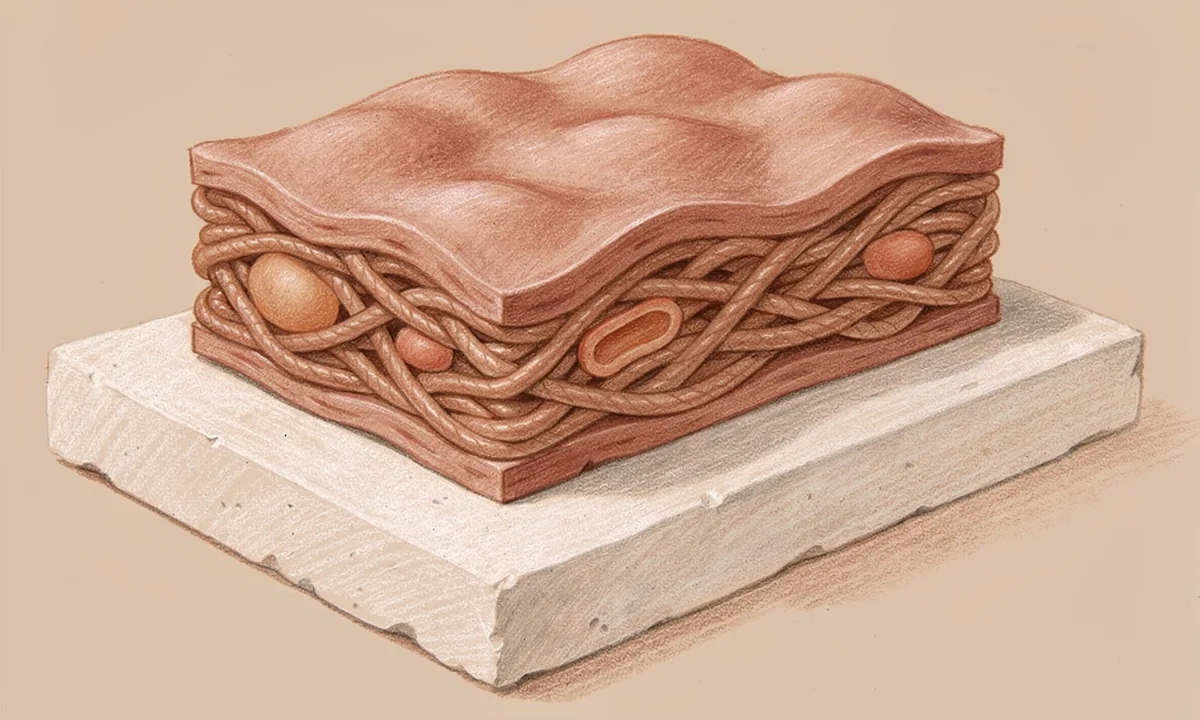
The tissue beneath the sheen
GHK-Cu has the strongest skin connection. The 2015 skin-regeneration review covers clinical and in vitro studies. Its matrix-synthesis observations in cell studies include stimulation of collagen, dermatan sulfate, chondroitin sulfate and decorin; its topical appearance findings include tighter skin, improved elasticity, density and firmness, and fewer fine lines and wrinkles.
A fibroblast is a cell that makes the supporting material around it. My curiosity runs beneath the sheen to the water-holding matrix: collagen gives structure, while the other substances help form that supporting material. The tissue-remodelling review also describes changes in how older material is broken down and new material laid down.
This makes topical copper-peptide research worth examining on its own terms. It does not make every skin claim attached to GLOW a result of that research. The complete GHK-Cu, BPC-157 and TB-500 combination has no human skin trial.
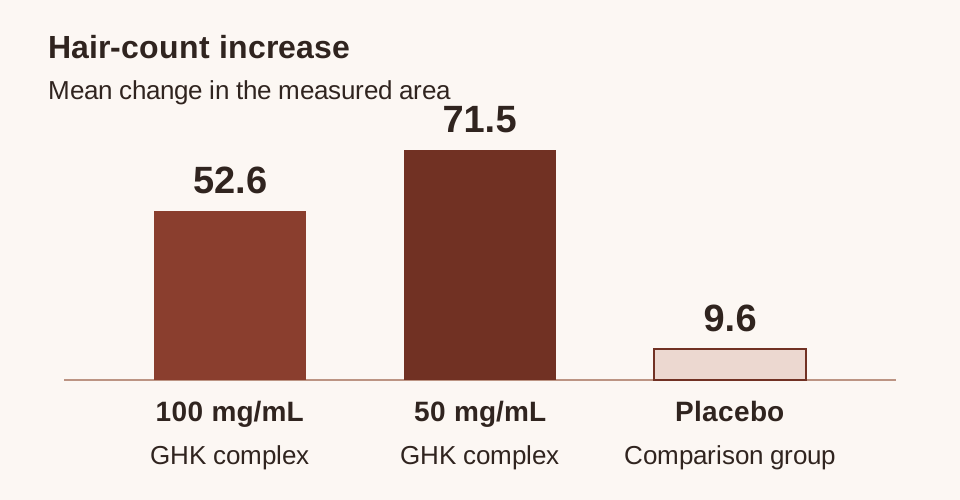
The lower concentration had the larger hair-count increase
The 2016 hair trial enrolled 45 men with androgenetic alopecia and ran for 6 months. It tested a topical complex of 5-aminolevulinic acid and glycyl-histidyl-lysine peptide. Mean hair-count increases in the measured area were 52.6 at 100 mg/mL, 71.5 at 50 mg/mL and 9.6 with placebo; the reported comparison with placebo was statistically significant at p<0.05. No adverse events were reported.
I expected the larger concentration to supply the larger figure. It did not. That reversal makes the study memorable, but it cannot establish that less is generally better. These group averages cover the area assessed; whole-scalp hair gains remain unmeasured.
The formulation matters as much as the numbers: it was a GHK combination with another ingredient; pure GHK-Cu and GLOW were both absent. A search for glow peptide before and after can land on this paper, but the endpoint was hair count; facial photographs and radiance scores were outside its scope.
Topical GHK-Cu and injected blends
Most of the human skin evidence discussed in the GHK-Cu review concerns topical formulations. Putting an ingredient on skin and injecting a three-part mixture are different exposures. The cited studies do not show that one reproduces the other.
For loose skin and fine lines, I am more persuaded by a limited claim tied to a topical preparation than by a sweeping claim that slips between cream, injection and blend. The amounts and chemistry page follows the same problem through formulation and clearance.
Full-length thymosin beta-4 in rat wounds
Full-length thymosin beta-4 increased re-epithelialization in rats, as well as collagen deposition and vessel formation. That is relevant repair biology. Skin tightening was outside the trial’s scope, and it did not use the TB-500 fragment in the GLOW blend.
My enthusiasm for those moving cells survives the qualification. The finding is more interesting when the animal, tissue and protein remain visible. It becomes less informative when all of them disappear behind a promise of better-looking skin.