GLOW peptide dosage has no tested recipe
An amount printed on a label, a concentration in a dish and an amount used in a safety trial describe different things. The copper adds another complication.
The label does not contain a clinical result
GLOW peptide dosage searches often end at a formulation label. The compositional note in the reference list records 10 mg BPC-157, 10 mg TB-500 and 50 mg GHK-Cu per vial as a research-label convention. Clinical dose validation is absent, and GLOW formulations vary across sources.
I see an inventory of ingredients in those figures. Nothing in the note establishes a human amount, frequency, treatment duration or reconstitution volume. There is no controlled human trial of the GLOW blend from which to derive them.
The reference list includes that compositional note explicitly. As a compositional note, it has no study URL or DOI. Giving a label the visual confidence of a formula would not turn it into one.
Study formulations and amounts
The GHK-Cu skin literature includes cell-culture work at 10^-12 to 10^-9 M and topical formulations approximately 0.05% to 2% by weight. A molar concentration describes material in a volume; a percentage by weight describes a formulation. Neither specifies a dose of the three-part blend.
The human BPC-157 safety pilot discussed in the BPC-157 review used intravenous 10 mg then 20 mg in two adults. Its tiny population and safety purpose matter as much as the amounts. It did not test a GLOW preparation or establish a regimen for people.
The full-length thymosin beta-4 Phase 1 trial used 42, 140, 420 and 1260 mg intravenously in 40 healthy volunteers. The material was the parent protein; the TB-500 fragment was absent. A regimen assembled from those amounts would splice together different subjects, routes and preparations.
Blue-violet is a chemical clue
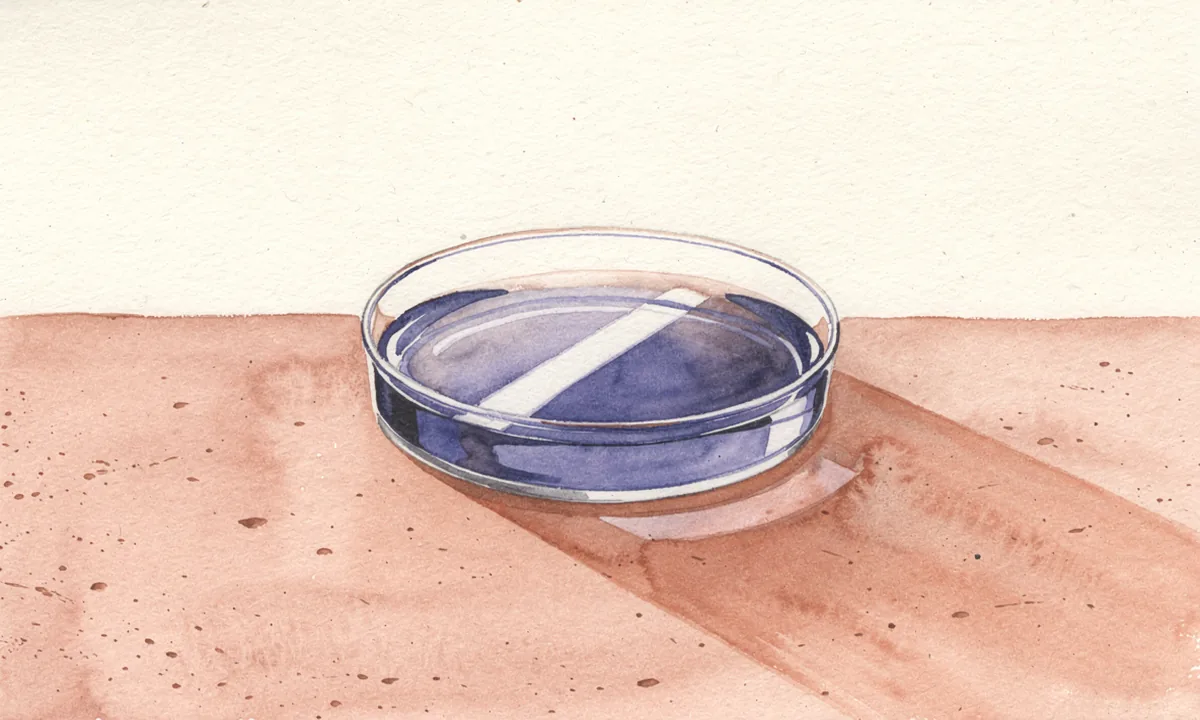
The GHK-Cu complex gives the material its blue-violet colour. The GHK-Cu literature describes greatest stability near pH 5-6.5; low-pH actives and strong reducing agents can disrupt the complex. The pH measures acidity; effectiveness requires separate evidence.
Copper colour delights me because its chemical explanation needs no beauty claim. It still cannot certify purity, concentration, sterility or the compatibility of all three ingredients. The papers offer no published blend-specific stability test that answers those questions.
Putting a copper complex beside other peptides raises questions about acidity and copper chemistry. Those compatibility questions remain unresolved; failure of the GLOW formulation remains unproved. I want measured stability data rather than an inference from how a preparation looks.
An injection changes the question
A glow peptide injection cannot borrow the entire history of topical GHK-Cu. The skin review mainly discusses topical work; the human thymosin beta-4 trial used an intravenous route and the full-length protein. Animal work and community accounts introduce still other exposures.
Accounts of subcutaneous GLOW use are anecdotal, not clinical evidence. The record supplies no controlled human pharmacology for that combined route, no established time to a result and no characterized clearance of the mixture. The separate ingredients' behaviour cannot set a common clock.
Laboratory handling of freeze-dried peptides does not resolve the human question either. GLOW has no standardized, clinically tested water volume. This page records study materials and the unresolved chemistry; it provides no preparation instructions or personal dosing plan.